#59 – Still Alice by Lisa Genova

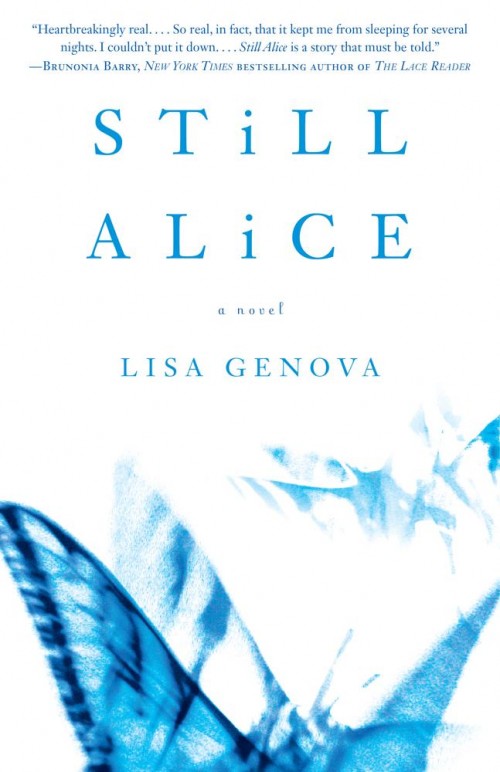
My RRHB has a saying whenever anyone asks him contracting advice about their basements: “you can’t win against water.” This saying kept echoing and echoing through my mind as I read Lisa Genova’s Still Alice last night into the wee hours because the baby woke up at 2AM, and I couldn’t get either to sleep or back to sleep, so I pretty much finished the book in one sitting. The only other Alzheimer’s-related story I’ve read is by Alice Munro, and it’s aching, brilliant and cutting at the same time (“The Bear Came Over the Mountain“) so I sort of expected the same emotional resonance that carried throughout that story to be found in this novel, and I don’t know why, but it’s just not there.

Alice, the title character, starts having strange episodes involving her memory. She’s a “brilliant” psychology professor at Harvard who has devoted her life to understanding linguistics, and her equally brilliant scientist of a husband might just cure cancer (honestly); the two share a wonderful life, three equally brilliant kids, and a whole host of truly awful dialogue as the episodes become diagnosed as early-onset Alzheimer’s. I know the book jacket tells me this is an award-winning NY Times bestseller but, for the life of me, I couldn’t understand why. It honestly read more like a really bad Lifetime movie of the week in parts, and I couldn’t abide by the melodrama.

Continue reading “#59 – Still Alice by Lisa Genova”

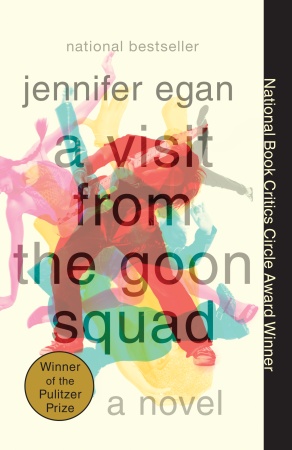
#57 – A Visit From The Goon Squad by Jennifer Egan

A Visit From the Good Squad coverWhat a rare book Jennifer Egan’s A Visit From the Good Squad turned out to be for me — one utterly and completely deserving of its rather exuberant praise and awards. This book swept me away from start to finish and the quirks that I would normally complain about (a la the entire chapter by the young Alison Blake) charmed me to no end because the writing is just that good. It’s more of a series of linked stories, Venn Diagrams of people’s lives as they interact, slip away, and then come into contact with someone else who can complete the tale rather than a traditional novel. The format feels innovative and new — parts of the book are told out of chronological order, some characters flicker in and out like fireflies, but Egan masterfully holds it all together with deft strokes and impressive sentences. I could not put this novel down.

Here’s the reading scenario: my son has Hand, Foot and Mouth disease. Yes, it’s as awful as it sounds. We spend a miserable evening at the emergency room in Peterborough for them to tell us that it’s a “virus.” He ran a fever of 104. He turned the colour of a lobster. My heart would not stop racing. And we spent a miserable night in the middle of a heat wave with him sobbing and trying to gain control over his fever — Egan’s novel was the only thing that kept me sane that night. I held him and read it. I rocked him and read it. He slept on me, and I read it. And when his fever didn’t break the next day and we had to head home to see the family doctor to get a further diagnosis (he had stopped eating and drinking at this point too), when I forgot the book in a panic to get home, I was devastated.

It’s a book, people. Continue reading “#57 – A Visit From The Goon Squad by Jennifer Egan”

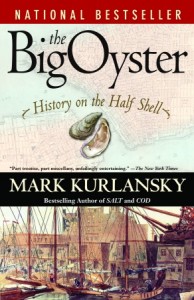
#56 – The Big Oyster by Mark Kurlansky

The Big Oyster - TP Edition

When I alphabetized by bookshelves to gain some order over the suburban sprawl of my TBR piles (read: four book shelves), I neglected to include any nonfiction in my overall reading strategy. I see now this was a mistake because I really love narrative nonfiction, especially when it’s well-written and about New York City. The Big Oyster: History on the Half Shell, while, yes, might be a bit repetitive and contain perhaps one too many historical recipes that feel like filler, fits the bill. I have never read anything else by Mark Kurlansky but I am ever-curious to read more of his nonfiction after finishing this book.

From the early Dutch settlers to the heyday of the Golden Age, New Yorkers have always consumed copious amounts of oysters. The social-anthropological thesis behind Kurlansky’s narrative fascinated me: human beings, in any situation, will simply ruin a natural, wonderful thing (oysters in the NY and surrounding harbours) by industry, profit and greed. And what’s worse, while the environmental message rings clear in this book, it’s amazing to me that even if they did bring the oysters back, the water at the bottom is so dead (no oxygen) that they wouldn’t survive. Ironically, as many activists point out, oysters are like vacuums cleaning up the waters for us. Annnywaay, that’s my rant about the ruination of our earth.

Back to the more fun things. It’s fascinating to examine the growth of a city through food — how it evolved, how it became an industry, and how said industry changed once the product disappeared for good. I loved how everyone in NYC: rich, poor, tourist, eats oysters — heck, my RRHB and I even took his parents to the beautiful oyster bar in Grand Central Station for dinner — all throughout history. Starting with the native peoples who first traded with the Dutch, through the English colonization and then downfall of their rule, and into the Golden Age, one thing remains constant: an unwaivering appetite for oysters among the inhabitants of one of the world’s greatest cities.  Continue reading “#56 – The Big Oyster by Mark Kurlansky”

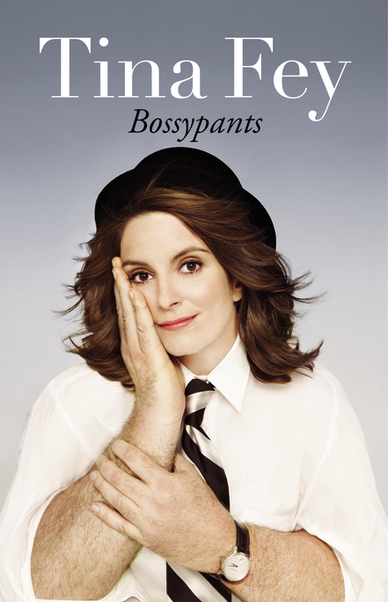
#55 – Bossypants by Tina Fey

BossypantsSummer reading generally means three things to me: extremely popular bestsellers, chunky classics that I never get around to finishing, and chicklit. I know I shouldn’t consider Bossypants chicklit, but, in a way, to me, it was. I am not downplaying Tina Fey’s obvious feminism or her ability to spin a good yarn — but it’s more the sense of where her comedy comes from, a deeply funny, incredibly awesome redefinition of girlie. She’s confident without being boastful, extremely thankful of all of her hard-won opportunities, but also wickedly aware of her own limitations, and the limitations of a “Hollywood” life. Maybe I’m reading too much into it — because it’s really more of a series of vignettes than narrative nonfiction, which made for incredibly easy reading. Perfect for a week at the cottage by yourself with an infant.

I laughed out loud and I found so much of Fey’s self-deprecating humour, her voice, and her ability to find a positive message for women in just about every situation that it’s hard to remember what a force for change she remains in the “industry” (I say that like I am actually “in” any “industry”). I never found the read tedious like so many celebrity “memoirs” (and yes, it deserves air quotes, come on, you know it does). It doesn’t feel ghostwritten or contain any deep-seeded confessions that turn my stomach a little even though I’m dying to read them anyway, ahem, Ashley Judd (let me tell you, when I was a tween, bedtime reading was Mommie Dearest; I know, it says a lot about me. In fact, Mommie Dearest coupled with Sweet Valley High, Louisa-May Alcott and Anne of Green Gables — not much has changed all these years later).

Continue reading “#55 – Bossypants by Tina Fey”

Notes From A House Frau: The Summer Edition

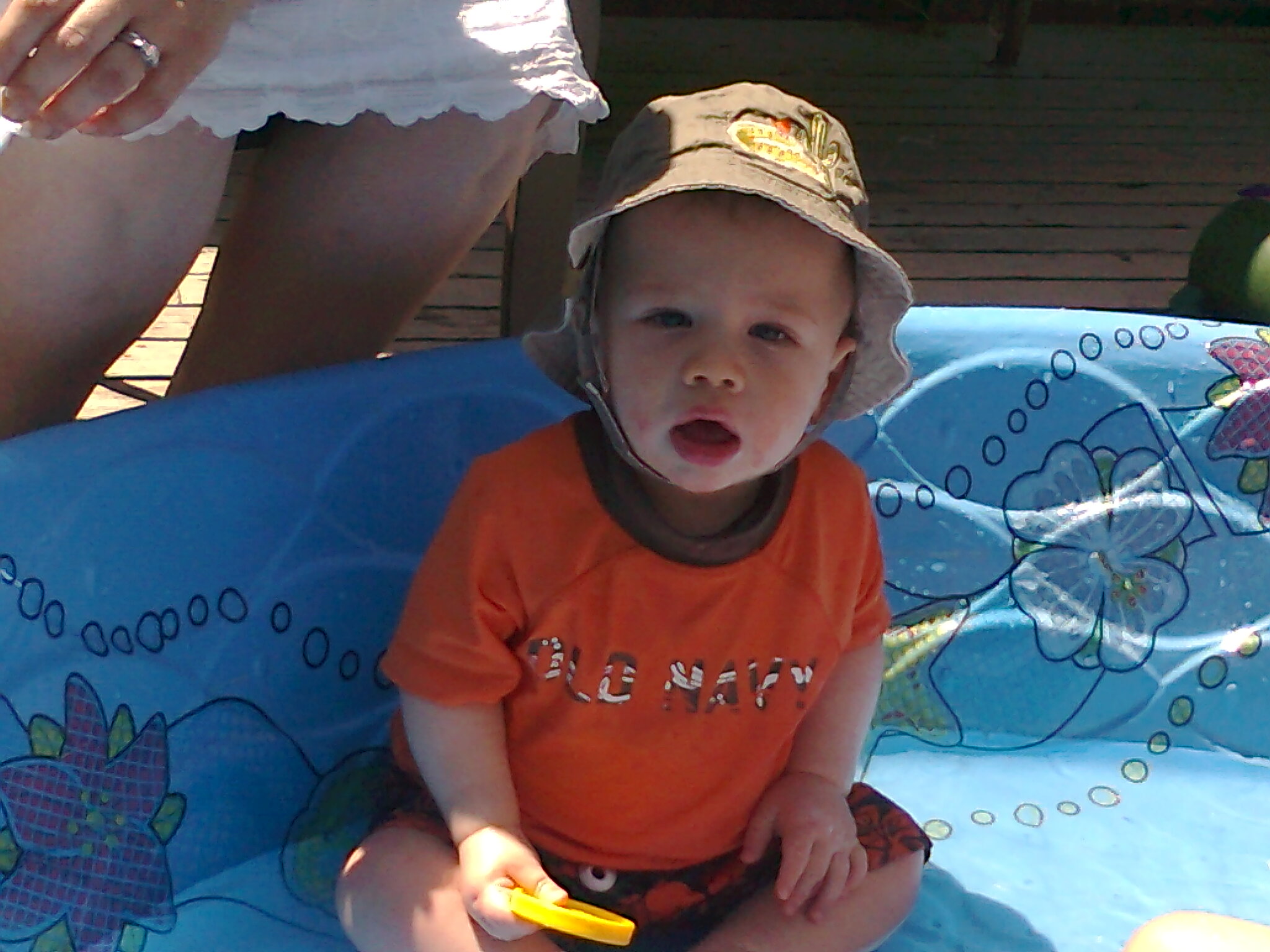
RRBB The summer seems to be moving so quickly, it’s hard to keep up with my real life let alone my virtual life. We’ve been spending lovely, long periods of time at the cottage, and the baby (while this particular photo isn’t at the cottage) seems to love the water, most of the time. Sometimes, it’s like anything, really, in life, it just takes a bit of getting used to.

It’s hard to believe that I’ve got about two months of maternity leave left. I’m going back a bit early, because I had taken off early because of all the crazy medical stuff surrounding my pregnancy. And, let’s face it, we are broke. But I am hanging on to what Gail Vaz-Oxlade says: emergency funds are for sickness, and boy have I ever had a crazy year. The latest? I have a stress fracture in my pelvis. That’s right, I have been walking around on a broken pelvis (no wonder it farking hurts) for the last few months. Who knows how it happened but it has something to do with the prednisone. Thankfully, I am taking 1/6 of the dose (from 60mgs to 10) that I was when we started this whole lungs-bleeding-disease-going-mental stuff started with the disease, and I hope that the new drug, the cyclophosphomide, is finally doing the trick.

We have gone beyond exhaustion these days. Luckily, our brilliant little baby excels at almost sleeping through the night. Regardless, the Wegener’s makes you tired, the drugs make you nauseous, sick, and tired, and taking care of an ever-going, never-stoping infant, well, I can barely string together a coherent thought let alone an entire blog post. But the weather has been beautiful and the temperature at the lake remains perfect for swimming. I’m trying to go every day but I don’t always get there. I am trying to make more of his baby food but I don’t always get there either. I am learning that the conveniences of life, while they make me feel guilty as hell, are meant to do just that help mothers like me who are less than healthy.

The most difficult part of dealing with an illness isn’t just the “oh, I’m sick part,” — for me, it’s always been about the loss. I never imagined how much I would love motherhood. Never thought it could become such an essential part of me so quickly. Before I got pregnant, our plans were never to have children, as I’ve written here before. Now, I can’t imagine my life any other way. And it’s not a little change — there’s a brand-new, entirely whole personality now attached to our lives and he takes up a lot of space. He’s a very impressive little one: moving around like a maniac, claiming his mind day by day as his own, deciding his likes and dislikes, putting every single thing in his path in his mouth. But it’s a welcome, wonderful new life, and even if it’s been a rocky road, maybe we’ve turned a corner. In my heart, I would have 27 more babies. I would fill my house up and numerous diaper pails, but I know it’s not reasonable. It’s not practical. I only have so many lives to lose. The disease will only give me so many second chances. So, no more babies for us. It’s the right choice. It’s the only choice. But it does break my heart a little, contemplating him on my birthday and in my favourite season at my favourite place in the world.

I had these grand plans a la Antonia Fraser to keep a summer diary. To take a picture every day and post it up here — a living journal of the only summer I’ve spent not working since I was a teenager. Maybe I will start in August. Maybe I will have more moments to actually prop open my eyes and my heart. Keep your fingers crossed for me: I see the Super-Fancy Disease Doctor on the 3rd. Let’s hope it’s only three months on the big guns, it’s reducing the prednisone and it’s healing up that fracture, and I can have one month, just four good weeks of awesome health before I am back to the daily grind and the whole new distinction of being a working mother.

#54 – Suddenly

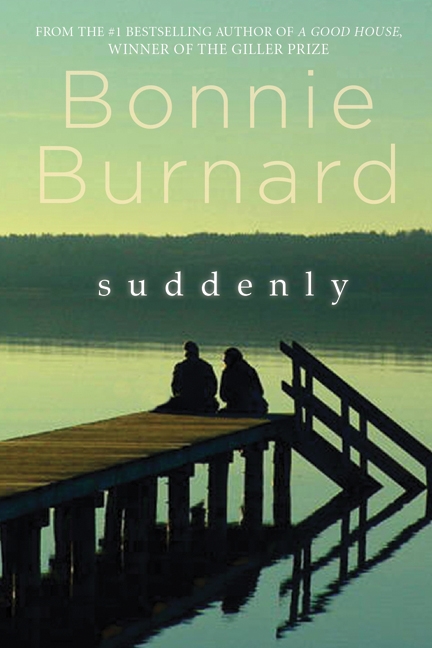
First, I am going to preface this review with a statement: I adored Bonnie Burnard’s The Good House. It’s a novel I picked up on a whim from Book City when it was first published and sang its praises to everyone who would listen for years. It’s a classic, right up there with The Stone Diaries, Clara Callan, and Away (book I read all around the same time), and so I was excited to read Bonnie Burnard’s latest novel Suddenly, if only because it’s the first one she’s published in 10 years. That’s a long time to wait.

Sadly, I probably never should have read this book. It’s neither the right time of my life (it’s a novel about truly middle-aged women) nor am I in the right frame of mind (having spent the last nine months battling my own life-threatening disease, I couldn’t quite cope with the breast cancer victim at the centre of the novel) to appreciate the gift of Suddenly. There’s no doubt in my mind that Bonnie Burnard’s a wonderful writer. She has an ability to bring the everyday to the page that’s unparalleled by many of her contemporaries. It’s a unique gift, and her voice reminds me deeply of Carol Shields, which is why I was so very disappointed in this book.

Sandra, our heroine, finds an evil lump in her breast at the end of the summer — her grandchildren have just gone back to the city with her husband, and she sits alone after a swim contemplating the hard reality of her future. Of course, her friend Jude has battled breast cancer and survived, and Sandra hopes she will too. Alas, it is not to be, and the majority of the novel takes place on her deathbed, that awesome Canadian-woman-writer-trope, where the family rallies around and all of the action takes place in reverse as the dying go through their lives, their relationships, their happiness and their regrets with a fine-toothed comb.

But one remains easily lost within this book because the point of view isn’t that simple, it switches from Sandra, to her best friend Colleen (who is beautiful, but childless, natch, and married to Sandra’s brother, the surgeon Richard), to her other best friend Jude (the ex-hippie, jilted by a Texan lover who left her on a farm to go fight the Vietnam war after casually fathering her son), to her husband Jack, and back again. It’s all over the place and the pronoun “she” doesn’t help matters when all three main characters are women…

It’s a tedious book, with tedious, unbelievable characters: Sandra’s a saint; so’s Colleen only she’s beautiful too, Jude’s “wild” but reformed, and they all feel so old they’re covered in a layer of dust. These are the women of my mother’s generation, one of them could have been my mother, and yet they have no sense of humour, no sense of adventure and really no life in them at all — even when it’s “flashing” before them as their best friend fades away in a cloud of morphine and horrible pain from an awful disease that takes far too many women. The title confused me for nothing happens quickly in this book — Burnard takes pages and pages to describe the most mundane aspects of everyday life, episodes that would have been best excised, and the whole novel would have been better for me if it read chronologically, if I got to see these women through their lives and not just as flashbacks in Sandra’s journals, which, of course, she kept religiously her entire life.

But I feel bad being so critical, which is why I think that my original statement, that it’s neither the right time of my life nor am I in the right mindset to contemplate a novel about someone so willingly giving in to a disease — not fearing death is one thing but Sandra’s utterly unrealistic in terms of her approach to illness; no one is as saintly as she’s portrayed on the page, no one. There’s no anger, and even when there is, it’s slightly ridiculous — two women having slight “words” during a winter storm and then poof, it’s back to celebrating Sandra and her ability to hold the other two women together. Yawn.

I much prefer Lionel Shriver’s approach to illness: frank, honest, angry, and also accepting — there’s something raw and real to how she writes about sickness, and I appreciated it. There’s tedium to being sick, to having tests, to being stuck in a bed, and anger, relentless, unceasing anger about the fact that your body just isn’t doing what it’s supposed to. And I’d hope that Sandra would have a glimpse of this throughout the book, that someone, anyone, might rage against the dying of the light just a little before rubbing more lotion on her cold feet or recalling some other wonderful thing she did during her abnormally normal life and marriage.

So don’t blame Burnard — it’s a great book club book for women of my mother’s age, it’s a terrific book to give your mother-in-law for Christmas, and it would have done wonders if Oprah’s Book Club still existed and ever considered that Canada has a literature from which to choose reading material. But Suddenly, with its long, drawn-out conclusion (Sandra dies! People mourn!) just didn’t cut it for me, a girl of a certain age who has battled a mean-ass frustrating disease for months.

#53 – The Retreat

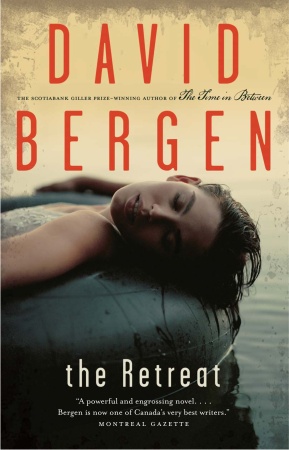
This may be hyperbole, but I think David Bergen is a national treasure. It’s quite a statement to say that over the course of reading four of his novels, his Giller winner (The Time in Between) remains my least favourite. People, it won a major prize! Overall, I devoured A Year of Lesser and See the Child, and thought they were both excellent. But The Retreatmight just be my favourite Bergen novel so far — but I haven’t read The Matter with Morris(just the first 50-odd pages for work), so I am reserving judgment until then.

The majority of the action in The Retreat takes place at a camp, the retreat of the novel’s title, near The Lake of the Woods, just outside of Kenora. The landscape, having spent about a week there at a cottage of an old ex-boyfriend way back in the way back, is beautiful. The Lake of the Woods itself is huge, with crisp blue waters, but the pond close to the property isn’t. It’s murky, filled with reeds, and just as dangerous — it’s an important distinction, because major accidents and/or incidents happen throughout the book on or close to the water, and Bergen’s ability to weave such an archetypal theme (man vs. nature) within his more specific, personal story, remains one of the book’s true accomplishments.

But let me digress. Raymond Seymour, an 18-year-old Ojibway boy, finds himself embroiled in an love affair with niece of the local police. Their relationship — hot and heavy — burns out quickly, and not just as a result of the intervention of her father and uncle but, because, it’s just not meant to last. Alice’s uncle takes Raymond out onto the Lake and dumps him on an island — expecting him not to return. This dynamic, bad cop/good kid, feels familiar, and it should, the relationship goes exactly where you expect and the penultimate action remains utterly heartbreaking. It’s 1974, and Bergen chooses as a secondary background of sorts, to wrap The Kenora Crisisaround his story, even though Raymond and his brother, who has just returned from being “raised” (read: forcibly removed) by a Mennonite family in the south, are tangentially involved in the uprising.

When Lizzie Byrd (17) and her family arrive at The Retreat, a quasi-commune run by “the Doctor,” a self-important, psycho-babbling fool who cons people into believing he can heal their souls by “talk” and the simple life of camp, she’s reluctant to participate. The births of her younger siblings have been hard on her mother, and her father desperately tries to save his family and her sanity by granting her every wish — in this case, it’s to spend the summer at The Retreat. Lizzie meets Raymond and a cautious friendship evolves into something more substantial. As the summer progresses, their feelings grow deeper, regardless of whether they truly understand one another’s complex situations (her crazy family; his unfortunate situation with the cop that never seems to end). But as the season comes to an end, the novel finds its conclusion — the characters, distraught, damaged and utterly changed by the events of the summer. It’s an amazingly quiet novel for the amount of emotional damage that is wrought on the people within, which remains Bergen’s exceptional ability as a writer — to place people in crisis and not let them entirely recover.

This is my favourite kind of book, a great setting, a complex, real issue that meant something in history, family dynamics that remain complex and difficult, and action that’s both believable and well-paced. In short, it’s an excellent read, probably one of the best books off my shelf. The Bs have been utterly kind to me (Barnes, Bergen, brilliant!).